
Choosing systemic-acting flea and tick treatments with the environment in mind

You’re reading a free article from Veterinary Prescriber, the independent medicines guidance resource for veterinary professionals. Subscribers get full access to our impartial analyses, comparison tables, CPD modules and unique Parasiticide Guide. See subscription options.
In this post:
Which are the systemic-acting products?
How they work and the difference between systemic-acting and topical-acting products
What we know about environmental safety
The importance of bagging and binning faeces
Bioavailability differences and effects of food on oral absorption
Products for dogs and cats - how they compare
Key points for reducing environmental exposure
Concerns about environmental contamination from topical ectoparasiticides (particularly spot-ons containing fipronil and imidacloprid) is prompting a shift in veterinary practice towards systemic-acting flea and tick treatments for cats and dogs, which might be seen as lower-risk alternatives. However, knowledge about the environmental fate and effects of the systemic-acting drugs is very limited.
Here, we compare the systemic-acting products available in the UK, focusing on drug absorption and excretion, to help clinicians make an environmentally conscious choice. We found that there are important differences between formulations that are relevant to the potential for ecotoxicity. There are also crucial messages for clients to help mitigate environmental exposure and ensure optimal efficacy of the treatments.
Which are the systemic-acting products?
Systemic-acting products contain one of the following active ingredients:
an isoxazoline (afoxolaner, esafoxolaner, fluralaner, lotilaner or sarolaner). These are active against fleas and ticks. Some products are also licensed for control of mites.
tigolaner. This has similar effects and uses to the isoxazolines, but is in a different chemical class (the bispyrazoles).
selamectin, a macrocyclic lactone (avermectin). This is active against fleas (adults, larvae and eggs), biting lice and mites (and also some worms). It is not active against ticks and is included with sarolaner in products that also cover ticks (e.g. Stronghold Plus).
The products have a long duration of effect, ranging from 1 month to 1 year, depending on the molecule and the formulation. They are mainly prescription-only (POM-V) but a few isoxazoline products for dogs are available to buy without a prescription (Advantage Chewable and Frontpro, in the NFA-VPS category).
Products containing nitenpyram (a neonicotinoid), which are available on general sale (AVM-GSL), (e.g. Capstar tablets) are given as single-dose, short-acting treatments for flea infestations. They do not have a persistent effect in the body.
How they work and the difference between systemic- and topical-acting products
After administering a systemic-acting product (a tablet, injection or spot-on), the drug is absorbed into the animal's body and kills parasites when they bite the animal and feed on subcutaneous tissue fluids and blood. They have a rapid flea-killing effect. The efficacy of these products is due to the absorbed drug. However, apart from the injection, not all the drug is absorbed into the body (see tables 2 and 3).
After applying a topical-acting product (a spot-on or collar), the product spreads from the site of application over the next day or so, in the fatty substances of the skin and hair to cover the whole body, where it remains for up to around 1 month. These products act through direct contact with parasites. Very little of the active ingredient is absorbed into the animal’s body. Spot-ons that work in this way contain: dinotefuran; fipronil; imidacloprid; pyriprole; indoxacarb. Collars (which contain imidacloprid and/or a pyrethroid) act in the same way and are also a depot for the active ingredient to provide efficacy for several months.
Many unknowns about environmental safety
Whether the systemic-acting products are overall safer for the environment than the topical-acting products is unknown because there is a lack of information about their environmental fate and effects (Wells and Collins 2022). In general, the chemicals are more fat-soluble and less water soluble than fipronil and imidacloprid, therefore their route to, and destination in, the environment may be different.
Not all the drug is absorbed into the body from systemic-acting spot-ons (see the tables); what happens to the unabsorbed portion is unknown. There is a potential for transfer to the environment and to humans who handle the animal.
After absorption of drug from any of the formulations, in general it is unknown whether and to what extent the drugs are distributed to the hair and skin of the treated animal. There is some evidence:
fluralaner is known to accumulate in skin and hair (EMA 2013; 2016) and has been found at concerning levels in swimming water following entry of an orally-treated dog (Diepen et al 2023).
selamectin has been found to be present in hair shed from treated dogs [EMA 2002]) and the SPC for Stronghold (selamectin) spot-on states that debris from selamectin-treated pets kills flea eggs and larvae not previously exposed to selamectin.
A small amount of the drugs may be excreted unchanged or as metabolites in the urine of treated animals. The environmental relevance of this is unknown.
Some of the drugs are excreted partly as metabolites but there is a lack of information about the relevance of this to environmental safety.
How long the drugs or their metabolites persist in the environment is unknown.
Reducing environmental exposure through collection of faeces
Absorbed isoxazoline, tigolaner and selamectin is mainly excreted unchanged in the faeces (see tables 2 and 3). Therefore, unlike the topical-acting products, there is the possibility of preventing environmental exposure to some extent by bagging and binning the faeces of treated animals; this is achievable for dogs but impractical for many cats. Bagging and binning needs to be done routinely because the drugs may continue to be excreted in faeces beyond the treatment period (Berny et al 2026).
It is important that clients are informed about the presence of parasiticide in pets' faeces because the product summaries of product characteristics (SPCs) or package leaflets do not routinely include instructions to bag and bin pets' faeces. The non-prescription brands Advantage Chewable and Frontpro, which were licensed most recently, do include this advice.
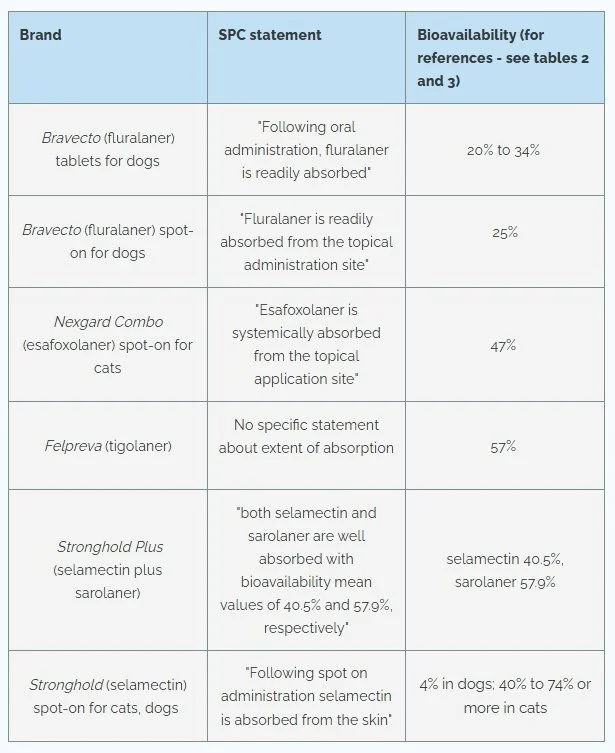
Table : SPC statements about absorption compared to reported bioavailability data
Bioavailability differences
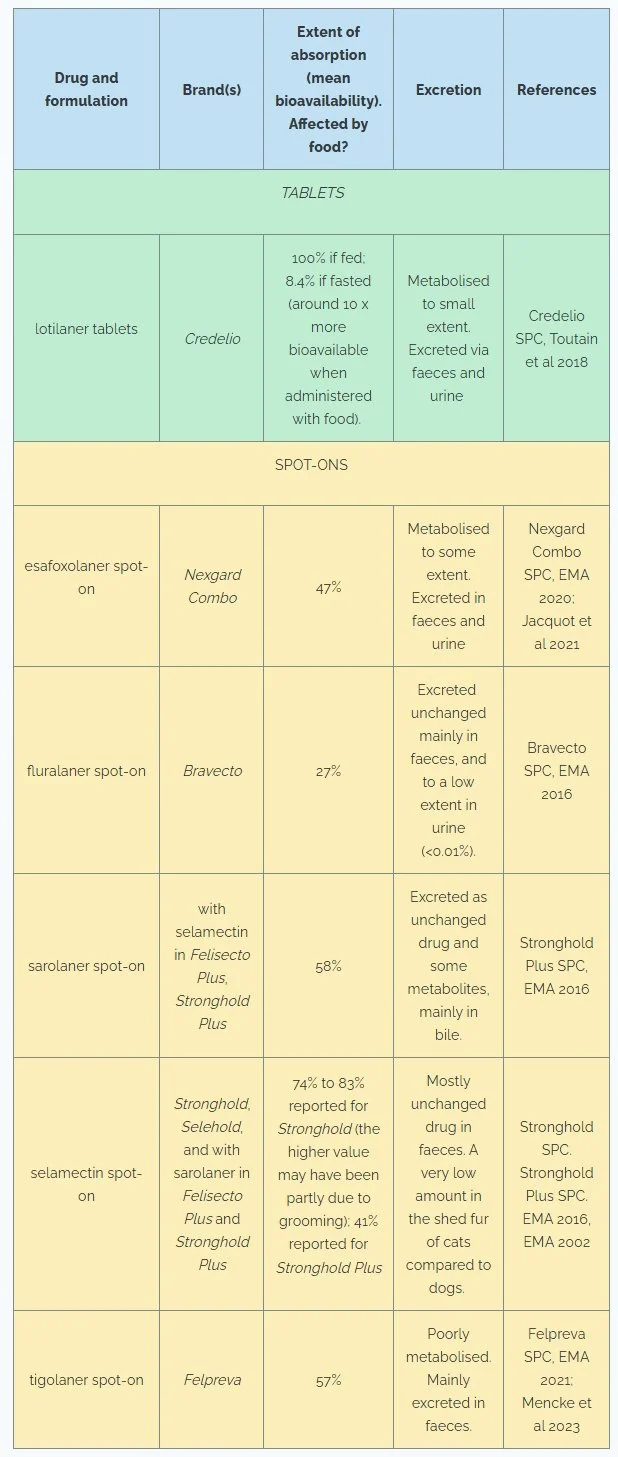
There is a difference between products in the extent to which the drug is absorbed into the bloodstream (bioavailability) - see the tables 2 and 3 below).
A lower bioavailability means that a larger dose of parasiticide is needed, as some will be lost in the faeces (oral products) or potentially to the surroundings (spot-ons). This is why the licensed dose of fluralaner when administered as Bravecto injection is less than for the tablet and spot-on. For more on this, there is a Veterinary Prescriber's review of Bravecto injection for dogs (subscription needed).
Notably, a high proportion of the drug applied as spot-on is not absorbed (see tables 2 and 3); absorption of selamectin in dogs is especially low. What happens to unabsorbed dose is unknown: presumably it remains on the body, so may potentally be lost to the surroundings and/or transferred to humans who handle the animal.
For many products the bioavailability data was to be found in the European Medicines Agency's regulatory reports or in published research, not in the SPCs, which are the more accessible information sources for veterinary professionals. Instead the SPCs typically include statements that might be assumed to mean that the drug is fully absorbed (see table 1, adjacent).
Effect of food on oral absorption
The absorption of fluralaner (Bravecto) and lotilaner (Credelio) tablets for cats and dogs is significantly affected by the presence of food in the stomach (see tables 2 and 3 below). Giving a lotilaner tablet with or within 30 minutes either side of a feed (comprising of at least a third of the daily ration) ensures optimal absorption (Toutain et al 2017; 2018).
As efficacy studies would have required the tablets to have been administered in a way that ensured optimal absorption, not administering these tablets correctly in relation to feeding could lead to underdosing, so potentially reduce efficacy and duration of effect, and favour resistance development.
The absorption of afoxolaner (Nexgard, Nexgard Spectra) and sarolaner (Simparica, Simparica Trio) tablets for dogs is not significantly affected by food.
Systemic-acting flea and tick products for dogs and cats - how they compare
Table 2: Products for dogs
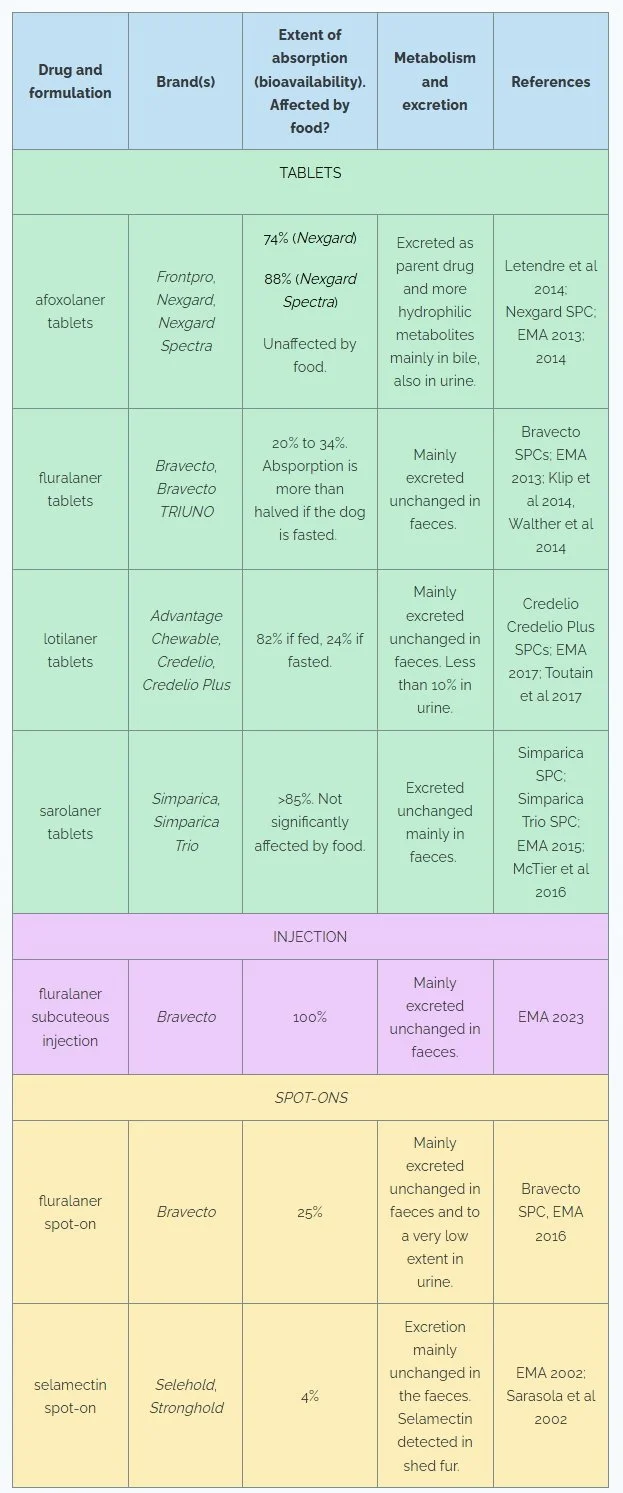
Table 3: Products for cats
Key points
There is a wide choice of systemic-acting treatments consisting of seven different drugs presented in a variety of formulations: tablets, spot-ons and injection for dogs; tablets and spot-ons for cats.
In order to kill parasites on the animal, the drugs in the systemic-acting products must be absorbed into the body from the formulation. Parasites are killed when they bite and take a blood meal. This is true for the spot-ons as well as the tablets and injection.
Bioavailability data show that a substantial portion of the applied dose of systemic-acting spot-ons is not absorbed, with a potential for transfer into the environment and to people who handle the animal. Unlike for tablets and injection, there is no way to capture the unabsorbed spot-on dose.
Parasiticide drug absorbed into the body from the formulations is excreted predominantly in faeces. This means it is possible to mitigate environmental exposure through bagging and binning of faeces.
Pet owners should be advised to always bag and bin pets' faeces to help prevent parasiticide drugs from getting into the environment. This advice is not routinely included the product information.
Absorption of drug from tablet formulations of fluralaner (Bravecto) and lotilaner (Credelio) is significantly affected by feeding status at the time of administration. The importance of giving these products with, or within about half an hour of, a feed comprising of at least a third of the daily ration, should be emphasised to pet owners to ensure optimal efficacy and avoid promoting resistance.
Producing independent, evidence‑based veterinary medicines guidance takes time, expertise and ongoing funding. Veterinary Prescriber takes no pharmaceutical advertising or sponsorship. Subscriptions from veterinary professionals enable us to keep doing work like this. Being independent allows us to be critical of evidence and promotion and to compare products. If you value impartial information that supports rational prescribing and environmental stewardship, please consider subscribing to Veterinary Prescriber. Not ready to subscribe? You can still stay in touch via our free Independent Veterinary Medicines Bulletin (IVMB), with highlights from our latest analyses, CPD modules, comparisons and news updates.
Want to know more?
Learn more about flea and tick treatments for cats and dogs in these Veterinary Prescriber reviews:
Making sense of flea and tick products
Advantage Chewable and Frontpro - two new non-prescription flea and tick treatments for dogs.
Flea and tick products and the environment
Need to compare authorised flea and tick products quickly? Use our unique Parasiticide Guide to search by species, parasite, route, and supply category.
All these resources, and more, are available to subscribers.
References
Berny PJ et al. (2026). Prolonged fecal elimination of isoxazoline antiparasitice drugs in dogs and cats: is there a risk for nontarget species? Environmental Toxicology and Chemistry 1-10. https://doi.org/10.1093/etojnl/vgaf285.
Diepen NJ et al. (2023). ‘Pet dogs transfer veterinary medicines to the environment’, Science of the Total Environment. The Authors, 858: pp.159550. doi: 10.1016/j.scitotenv.2022.159550.
EMA. (2002). Product profile. Stronghold. CVMP/665/99-Rev.2
EMA (2013). CVMP assessment report for Bravecto (EMEA/V/C/002526/0000)
EMA. (2013). CVMP assessment report for Nexgard (EMEA/V/C/002729/0000)
EMA. (2015). CVMP assessment report for Simparica (EMEA/V/C/003991/0000)
EMA. (2014). CVMP Assessment Report for NEXGARD SPECTRA (EMEA/V/C/003842/0000)
EMA. (2016). CVMP assessment report for Bravecto for spot-on solution for dogs and cats (EMEA/V/C/002526/X/0005).
EMA. (2016) CVMP assessment report for Stronghold Plus (EMEA/V/C/004194/0000).
EMA. (2017) CVMP assessment report for Credelio (EMEA/V/C/004247/0000)
EMA. (2020) CVMP assessment report for NexGard Combo (EMEA/V/C/005094/0000)
EMA. (2021) CVMP assessment report for Felpreva (EMEA/V/C/005464/0000)
EMA. (2023). CVMP assessment report for a variation requiring assessment for Bravecto ( EMEA / V / C / 002526 / VRA / 0059 ).
Jacquot V et al. (2021). Pharmacokinetics of a novel endectoparasiticide topical formulation for cats, combining esafoxolaner, eprinomectin and praziquantel. Parasite, 28, Article 19. https://doi.org/10.1051/parasite/2021014
Klip S et al. (2014). Pharmacokinetics of fluralaner in dogs following a single oral or intravenous administration. Parasites and Vectors 7: 85.
Kilp S et al. (2016). Comparative pharmacokinetics of fluralaner in dogs and cats following single topical or intravenous administration. Parasites & Vectors, 9, Article 296. https://doi.org/10.1186/s13071-016-1564-8
Letendre L et al. (2014). The intravenous and oral pharmacokinetics of afoxolaner used as a monthly chewable antiparasitic for dogs. Veterinary Parasitology, 201, 190-197. https://doi.org/10.1016/j.vetpar.2014.02.021
McTier T. L et al. (2016). Discovery of sarolaner: a novel, orally administered , broad-spectrum, isoxazoline ectoparasiticide for dogs. Veterinary Parasitology, 222, 3-11. https://doi.org/10.1016/j.vetpar.2016.02.019
Mencke N et al. (2023). Plasma pharmacokinetics of tigolaner, emodepside, and praziquantel following topical administration of a combination product (Felpreva®) and of intravenous administration of the individual active ingredients in cats. Current Research in Parasitology & Vector-Borne Diseases, 4, Article 100126. https://doi.org/10.1016/j.crpvbd.2023.100126
Sarasola P et al. (2002). Pharmacokinetics of selamectin following intravenous, oral and topical administration in cats and dogs. J Veterinary Pharmacology and Therapeutics. 5 September. https://doi.org/10.1046/j.1365-2885.2002.00415.x
Summaries of Products Characteristics for all authorised veterinary medicines. VMD Product information database. https://www.gov.uk/check-animal-medicine-licensed
Toutain CE et al. (2017). The intravenous and oral pharmacokinetics of lotilaner in dogs. Parasites & Vectors, 10, Article 522. https://doi.org/10.1186/s13071-017-2475-z
Toutain CE et al. (2018). Pharmacokinetics of lotilaner following a single oral or intravenous administration in cats. Parasites and Vectors. https://pmc.ncbi.nlm.nih.gov/articles/PMC6044034/
Walther FM et al. (2014) The effect of food on the pharmacokinetics of oral fluralaner in dogs. Parasit Vectors. 84.
Wells C, Collins CMT. (2022). A rapid evidence assessment of the potential risk to the environment presented by active ingredients in the UK’s most commonly sold companion animal parasiticides. Environ Sci Pollut Res.45070-45088. doi:10.1007/s11356-022-20204-2